Laura Risk: Scottish and Québécois fiddling.

I recently finished a PhD in musicology at McGill University. My thesis research was on traditional music in Quebec, but I had the pleasure of working on a number of other fascinating projects over the last few years. Here are two: the diffusion of the string instrument technique called "chopping," and the life and music of jazz violinist Ginger Smock.
 THE CHOP
In 2013, I wrote an article about the spread of "chopping" into various North Atlantic fiddling genres. That article was published in the academic journal Ethnomusicology. If you have access to Ethnomusiocology via your local or university library, you can read the article here: http://www.jstor.org/stable/10.5406/ethnomusicology.57.3.0428. If not, here is the full PDF for download. Enjoy!
GINGER SMOCK
I've also been doing some research into the life and music of Ginger Smock, a jazz and classical violinist active in Los Angeles from the 1940s through the 1960s. She was the musical host for at least two television shows -– one of the first African-American women to hold such a position -- and toured nationally with Steve Gibson and the Red Caps in the mid-50s. In the early 1970s Smock moved to Las Vegas, where she was concertmaster in top show orchestras.
 I first learned about Ginger Smock via the excellent CD Strange Blues: Ginger Smock, The Lovely Lady with the Violin, Los Angeles Studio & Demo Recordings 1946-1958. This album was compiled by jazz violin historian Anthony Barnett and released on his AB Fable label in 2005 (ABCD1-010). I was taken by Smock's bold, virtuosic, horn-like solos and what began as a side project (a seminar paper for Dr. Lisa Barg's "Gender and Jazz" course at McGill University) quickly became a substantial research interest. In the following sections I give some information about Smock's career and discuss her absence from jazz history. I've organized this page according to some of the questions I'm most often asked.
My primary sources are historical periodicals, in particular African-American newspapers such as the Los Angeles Sentinel and the California Eagle. Other invaluable sources include Anthony Barnett’s liner notes to Strange Blues and his Violin Improvisation Studies Updates; Bette Yarbrough Cox's Central Avenue: Its Rise and Fall (1890 - c1955), which was published in 1996 and includes a 1983 interview with Smock; Central Avenue Sounds: Jazz in Los Angeles, edited by Clora Bryant, Buddy Collette, et al. (publ. 1995); and an unpublished 1993 interview of Smock by Sherrie Tucker. I would like to thank Dr. Tucker for granting me access to her full transcription of the latter interview.
Most recently, I've had the pleasure of working with Smock's extended family and with the family of Canadian jazz violin collector John Reeves to bring their private collections to the Smithsonian National Museum of African American History and Culture. The NMAAHC is currently featuring Ginger Smock in their online Collection Stories series.
This project is ongoing and I welcome all comments, suggestions and additional information.
Who was Ginger Smock?
Emma “Ginger” Smock was born in Chicago in 1920 but moved to Los Angeles at the age of six to live with her aunt and uncle. She was one of many accomplished musicians to come out of the vibrant African-American community on and around Central Avenue in south-central L.A.; other powerful women instrumentalists from Central Avenue include Clora Bryant, Melba Liston, Vi Reed, Nellie Lutcher, Betty Hall Jones and Erma Young. The commuity placed a high priority on music education as "one means towards advancement in the future,” according to local music educator Bette Yarbrough Cox, and many working- and middle-class Central Avenue families “made every effort to find a way, through any sacrifice, to see that their children had music lessons" (Cox 1996, 14).
Smock showed early promise as a classical violinist and at the age of ten performed at the Hollywood Bowl to a standing ovation. She studied at Jefferson High School under the celebrated orchestra and band leader Sam Browne; her classmate Jackie Kelso remembers Smock playing "anything and everything that needed to be played with great finesse and quality of performance” (Bryant et al. 1998, 211). Smock attended Los Angeles City College and the Zoellner Conservatory of Music and played first violin with the All-City Orchestra, the Junior Philharmonic, and the Southeast Symphony. A later profile of Smock in DownBeat magazine (1951) indicates that she thought "she was headed for the concert stage" -- presumably an orchestra career -- though she likely knew the odds were stacked against her: in the early 1940s, when Smock finished her schooling, not one African American had been hired to play professionally with an American orchestra.
In 1943, Smock was called to substitute for jazz violinist Stuff Smith on a local club date. At the time, Smock still considered herself a “concert violinist and a church violinist,” though she was a fan of Duke Ellington, Count Basie, Benny Goodman, Glenn Miller and jazz violinists Joe Venuti, Eddie South and Smith himself. As a child, Smock “used to sit by the phonograph and improvise with their records. Then I started doing it for the kids in the school orchestra, just for fun. They liked it” (DownBeat, June 15, 1951, 8).
Smock's performing career took off in the mid-1940s. From 1943 through '45 or '46, she played local clubs with The Sepia Tones (Mata Roy on piano, Nina Russell on Hammond organ). The trio's repertoire ranged from “classics to semiclassics to blues,” including “Rhapsody in Blue,” “Persian Market,” “Holiday for Strings” and “Poinciana,” and they “pack[ed] them in” at The Last Word club (The Plaindealer, May 5, 1944). Smock performed with another all-women combo, The Three V's (later The Four V's), in the same years. In 1945 or '46, Smock founded the ensemble Ginger and Her Magic Notes (Harvey Brooks on piano, Herman Mitchell on guitar and bass, with appearances at The Waikiki Inn and The Coconut Grove in Santa Monica); she also performed with Brooks at The Waikiki as “Sweetheart of the Strings” Ginger Smock and Her Trio from 1946 or '47. In late 1947, Smock “scored a smash success" as the "First Lady of the Violin" in a revue at The Last Word and, by the end of opening week, had four San Francisco clubs "bidding against each other for her services” (Cleveland Call and Post, November 15, 1947).
Smock’s recording career began in 1946 as sidewoman on two sides by Joe Alexander and the Red Callender Quintet. In September of that year she cut four sides with the Vivien Garry Quartet for RCA Victor’s Girls in Jazz series, playing a Beauchamp Rickenbacker Electro violin. The session was organized and supervised by renowned jazz producer Leonard Feather. (For extensive details regarding Smock's recording career, see the liner notes to Strange Blues and Barnett's Violin Improvisation Studies Updates).
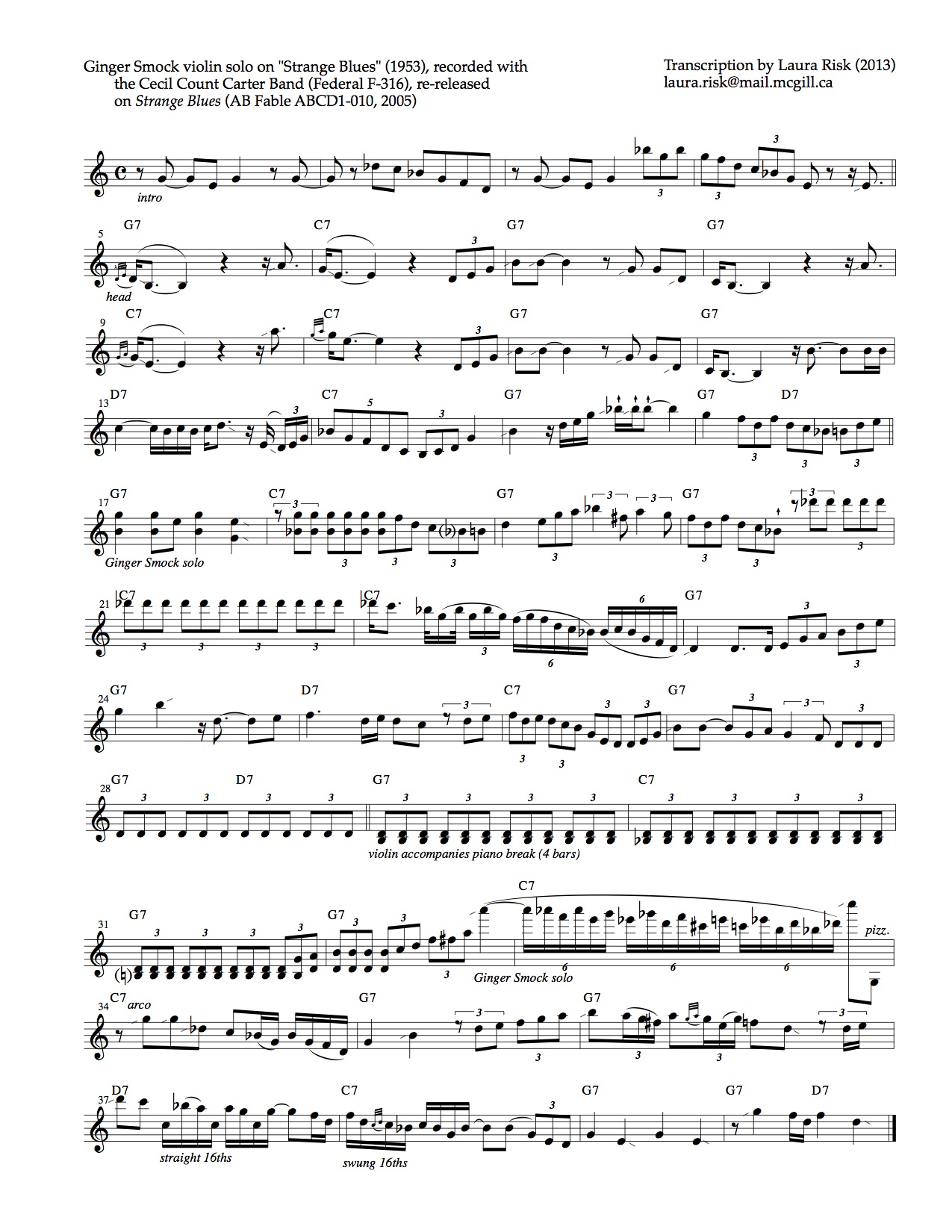
Smock brings a raucous, hard-swinging intensity to her solo on “A Woman’s Place is in the Groove” in these 1946 sessions, though the narrow compass and straightforward phrase structure of her musical ideas point to her relative inexperience. Over the following decade Smock honed her jazz skills playing local clubs, as described above, and made frequent appearances on Los Angeles radio and television variety shows (see below). Her composition “Strange Blues,” recorded with the Cecil Count Carter Band in March 1953 for the Federal label, evidences a mature musical voice: her solo is rhythmically complex, technically demanding, alternately sassy and delicate, with long melodic lines spun out across the changes. She has assimiliated not only Stuff Smith’s wide vibrato, conspicuous slides, horn-like phrase structures, and thoroughly bluesy harmonic language, but also the sweetness of tone and technical virtuosity of the likes of Stephane Grappelli and Eddie South.
Both “A Woman’s Place is in the Groove” and “Strange Blues” are on the CD Strange Blues. Here is my transcription of Smock's solo on "Strange Blues":
Smock’s variety television credits include a spot as bandleader on a short-lived CBS television show, The Chicks and the Fiddle (1951); three years on Dixie Showboat (1951-53); emcee and bandleader for Rhythm Review (1958-59); and guest appearances on Spade Cooley’s immensely popular The Hoffman Hayride. (I describe one of her television appearances in detail below.) According to Jet magazine, Smock was a television natural:
On the show [Dixie Showboat] less than two months she has become as well known to TV viewers as artists who have appeared much longer.... [On The Chicks and the Fiddle] she was a smash hit in the role [of bandleader]. Since that time, she has constantly been in demand for guest bits on TV, [and] has shown on four of Los Angeles’ major video stations. (April 24, 1952)
In 1953, Smock toured the West Coast with the Jackson Brothers Orchestra and by the following year was on the road with Steve Gibson and the Red Caps, performing at venues such as the El Rancho in Las Vegas, the Latin Casino in Washington D.C., and Ciro’s in Philadelphia and Miami. Upon her return to Los Angeles in 1955, she played an Egyptian court musician in Cecil B. DeMille’s “The Ten Commandments,” performed with Hal Jackson’s Tornados, and from 1956 until 1958 appeared nightly at the Rubyiat Lounge of the Watkins Hotel.
For four years in the 1960s, Smock was the music director for the cruise ship S.S. Catalina (between Los Angeles and the Catalina Islands), the first woman to hold that position. During the winter months, “Ginger and Her Shipmates” migrated to Las Vegas to play at venues such as the Flamingo, the Last Frontier, the New Frontier, and the El Cortez. The band released one album of "original island music," On the S.S. Catalina with the Shipmates and Ginger (1961; Cox 1996, 312). 
Even as her career blossomed, Smock continued to play for her church and for local benefit events. As an example, in the five months between February and June 1952, Smock provided entertainment at the People’s Independent Church fashion show; performed at the closing reception of the Negro History Week observance of the local Association for the Study of Negro Life and History; appeared at a Pre-Easter Style Show sponsored by the Women’s Council of the Greater Faith Baptist Church; took part in a tribute evening to mothers organized by Symphony Chapter No. 43, a woman’s club; and performed at an All Nations Fashion Revue and Blue Book Tea honoring a local councilman and an assemblyman. She was also a featured performer -- second only in billing to Harpo Marx -- in the annual People’s Independent Church Easter benefit show for the St. Augustine Westview Hospital.
In 1960, Smock was invited to play in the show orchestra for Sammy Davis, Jr. and over the following three decades, she played in Las Vegas show orchestras at The Sands, The Flamingo, Ceaser’s Palace and The Tropicana, where she served as concertmaster. In 1965, she received an award from the City of Los Angeles recognizing her cultural contributions; by 1971, however, Smock and her husband had moved to Las Vegas. She was musically active until her final years, playing weekly at her church, but towards the end of her life she played little jazz. Ginger Smock died in 1995.
If Ginger Smock was so famous, how is it that I've never heard of her?
Jazz history is essentially a history of recordings, and I think Smock's historical absence may be attributed in large part to a lack of recorded material. In fact, the posthumous CD Strange Blues (2005) is Smock's only full-length album other than her 1961 "island music" LP, On the S.S. Catalina with the Shipmates and Ginger. Particularly notable on Strange Blues are the ten previously unreleased demo tracks -- these suggest a woman who worked hard for a recording under her own name but was ultimately unsuccessful. It is hard to know exactly why so many of Smock's recordings were not commercially released. However, she herself recognized that race and gender had at times played against her; in 1993 she told Dr. Sherrie Tucker about a talent scout from RCA Victor who had heard her with the Jackson Brothers' band in San Francisco (probably in 1953) and requested that she record a few numbers for him to bring back to the "bigwigs":
He told the executives, “Sit down, I want you to hear something.” So when he finished playing the two numbers, these guys were so impressed, they said, “Who on earth is playing the violin? We've never heard anything like this.” And he says, “A colored girl up there in San Francisco.” They said, “Aw, forget it. We've got Joe Venuti." (Pacific Review of Ethnomusicology, Winter 1996/1997, 9)
Jazz history is also a history of reception -- how performers and recordings were received by audiences and critics -- and in mid-twentieth century America, women jazz instrumentalists were rarely judged for their music. Rather, they were judged on physical terms: their bodies, their stage presence, their sex appeal, and their skin tone were all fair game for comment and critique. Women instrumentalists were novel and superficial acts by definition. As Sherrie Tucker has written, "with the exception of piano, most jazz instruments were considered 'normal' in the hands of men, and a 'gimmick' in the hands of women... [E]mployers and audiences generally expected [all-women groups] to stick with a less challenging swing and novelty repertoire, a fact-of-life which frustrated many women jazz musicians" (Pacific Review of Ethnomusicology, Winter 1996/1997, 18-19).
A glance through the pages of DownBeat magazine in the late 1940s and early 1950s suggests that women were granted print space only as sexually-available bodies, wives, tragic failures, “girl singers,” male “discoveries” or, occasionally, the focus of other women’s derision. Even the series of feature articles on “Girls in Jazz” that Leonard Feather penned for DownBeat in 1951 tends towards defeatist rhetoric: "A good-looking redhead who sings, and can play the coolest trumpet this side of Miles Davis – it sounds like the stuff of which hip dreams are made. But it hasn’t done Norma Carson much good" (April 6, 3); "Mary Osbourne, girl singer and girl guitarist extraordinary... still has youth and beauty and talent, but it is hard to say how long these qualities will endure before she can be considered to have missed the gravy train forever" (May 18, 4-5).
 DownBeat's "Hollywood Beat" reporter Hal Holly profiled Ginger Smock for the magazine on June 15, 1951. Although by this time Smock was nearly a decade into a flourishing career, Holly mentions only one item of work experience (the 1946 recording session produced by Holly's colleague Leonard Feather) and paints Smock as a young, struggling musician. In fact, she is completely absent from the headline -- “Addition to ‘Girls in Jazz’ Found on Coast by Holly” -- which instead sets up a friendly battle between Feather and Holly as men hoping to discover female bodies playing jazz.
The available documentation suggests that Smock herself understood and accepted that a woman instrumentalist on stage in the 1950s was both artist and object, and she played along with a thoroughly matter-of-fact attitude. Her classmate Jackie Kelso described her as a practical musician whose success derived in part, as he put it, from a willingness to "find out what product is being sold on the market and [to] make sure that you can do [it]" (UCLA Oral History Project). Smock was “The Bronze Gypsy” and “The Lovely Lady with the Violin” and, according to Jet magazine, cultivated a "bombastic" stage personality, "stomp[ing] her feet, sway[ing] her head and gyrat[ing] her arms in lively rhythm" (April 24, 1952, 62-63). Her instrumental technique allowed her to perform in a variety of styles, from jazz to classical to various popular styles, and she used this versatility to secure a wide variety of performing opportunities.
What were Ginger Smock's television appearances like?
Virtually no footage remains from Ginger Smock's many on-screen performances. However, in 2011 I discovered one episode of Dixie Showboat, probably dating from the fall of 1951, at the UCLA Film and Television Archives (KTLA, Dixie Showboat no. 33, UCLA Film and Television Archives #VA22699 T, original broadcast date unknown). This is, to the best of my knowledge, the only extant video of Smock from her television days. Here is my description of, and reflection on, her five-minute segment:
The show is set on a steamboat making its way down the Mississippi River towards New Orleans sometime around the turn of the last century. (The sponsor, Milani Foods, used Dixie Showboat to promote its “1890” salad dressing.) An imagined world of Southern racial harmony is on conspicuous display, with the center of the stage occupied by a row of young children who have clearly been seated by race: a white girl, a black girl, a white boy, and so on. The performers include house band Nappy Lamure and his Straw Hat Strutters; singers Jacqueline Fontaine and Scatman Crothers; accordionist Tony Lovello; “stand-up pianist” Maurice Rocco; the Dixiettes dancing trio, and an unnamed group of “south of the border” dancers. Typical for the time, however, Dixie Showboat also indulges in the stereotype of what Donald Bogle has called “pure coons”: black men as “unreliable, crazy, lazy, subhuman creatures” (1994, 8). A recurring feature on the show is the African-American comedy duo Peanuts and Popcorn, who perform short minstrel-style routines.
About ten minutes into this episode of Dixie Showboat, Dick Lane, the ship’s captain and the show’s host, approaches Ginger Smock, who is seated stage right among other “passengers.” Although this may be a case of a known star guesting on television as a nobody, I think it is more likely that Smock was, in fact, largely unknown to the Dixie Showboat studio audience: there is no appreciative applause or knowing laughter. Lane says to Smock, “Ma’am... you seem totally fascinated by this orchestra [the house band] and the music.” “Oh, I am. I definitely am,” replies Smock. The captain contines, “You appreciate good music,” and she responds, “Oh, but I do.” Smock speaks her lines with a flat Califonia accent, which I take to be her normal speaking voice, but on the next line her voice changes. The captain says, “Are you a musician?” and she shakes her head and says in a high, strained voice with a fake Southern accent, “Well, I’m trying to be.”
Next the captain asks her name and instrument and Smock replies in her normal, California voice. Then he asks if she would “mind playing… a little something” on her violin, which she conveniently has lying in an open case at her side. Smock again puts on a Southern accent and allows her voice to rise to a high, incredulous pitch as she replies, “Well, I wouldn’t mind, but in front of all these people and with a great big band with me?” The captain insists that she play, she requests “What Is This Thing Called Love” and then, with a huge smile, she takes center stage.
Smock first plays the melody with beautiful classical tone and technique, adding in double stops and virtuosic runs. She stands tall and straight, her eyes often closed, her face concentrated. Towards the end of the form, she cracks a small smile, the band switches to a swing rhythm, Smock breaks into a high-energy solo, and her posture changes completely: she starts moving to the music, her hips shifting from side to side. When she plays an extended run of ascending tremolo scales, the audience begins clapping and she smiles in response. On the final phrase, she shifts higher, swings harder, strums a few pizzacato notes precisely in time with the house band and stops short, flinging her arm out as the horns play a long note. She takes a slight bow. With a nod to the captain, a big smile, and a bounce in her step, Ginger Smock walks back to her seat and disappears from our view for thirty years.
Why did Ginger Smock’s voice change so dramatically during her speaking part? Perhaps she was meant to play a Southern character throughout but was unable to maintain the correct accent. Perhaps those two lines were scripted – about trying to be a musician and being scared to play in front of a crowd – and she had ad libbed the rest. Or perhaps Smock’s response to questions that ignored her entire professional career to date (bandleader, recording artist, popular performer with long-running club engagements) was to overexaggerate her responses and thereby make a mockery of the question. But watching how Smock smiles at the captain after she delivers her line about playing “in front of all these people,” I think: she is playing a game. She knows that the minute she puts her bow to the strings, no one will remember that she has been cast as a meek, girlish, insecure amateur. She will take the stage and her musical and physical presence will erase whatever historical absence has been assigned to her.
*****
Comments, questions, suggestions? Please send me an email at laura.risk@mail.mcgill.ca
All text ©2018 Laura Risk. Please do not copy or cite without permission.